FABULOUS TRANSFORMATION® is Griefwork Center, Inc.’s proprietary, evidence-informed methodology for helping professionals and organizations address the emotional and occupational impact of work involving trauma, grief, loss, and caregiving. Rather than focusing only on coping with compassion fatigue, vicarious trauma, and other forms of occupational stress, the framework provides a structured path toward resilience, meaning, connection, and professional growth.

Developed by Griefwork Center founder Barbara Rubel more than two decades ago, FABULOUS TRANSFORMATION® grew from her work with professionals whose roles regularly bring them into contact with the pain, trauma, grief, and life-changing experiences of others. Barbara recognized that the impact of this work extends beyond ordinary workplace stress—and that lasting resilience requires more than simply managing symptoms or “bouncing back.”

At the heart of FABULOUS TRANSFORMATION® is the belief that difficult professional experiences can be understood, processed, and integrated in ways that support growth. The goal is not to return people to exactly where they were before. It is to help professionals and organizations move forward with greater awareness, stronger connections, renewed meaning, and a deeper sense of purpose in the work they do.

The Eight Dimensions of FABULOUS TRANSFORMATION®

FABULOUS TRANSFORMATION® brings together eight interconnected dimensions that help professionals understand and respond to the impact of emotionally demanding work while also recognizing the workplace conditions that influence well-being. Each dimension contributes a different part of the transformation:


F – Flexibility
Develop the ability to adapt thoughts, emotions, and responses as circumstances change. Emotional flexibility supports resilience by helping professionals move beyond rigid coping patterns, reframe difficult experiences, and respond more effectively to workplace challenges.

A – Attitude
Recognize how mindset, perceptions, and emotional responses shape the way occupational stress and compassion fatigue are experienced. Greater awareness creates opportunities to shift perspective and respond more intentionally.

B – Boundaries
Establish healthy professional and personal limits that protect emotional resources without creating emotional distance. Effective boundaries support ethical, compassionate work while helping professionals preserve their own well-being.

U – Understanding Job Satisfaction
Explore the personal and organizational factors that influence fulfillment, motivation, performance, and the desire to remain in one’s work. Purpose and values matter, but so do leadership, recognition, workplace culture, policies, relationships, resources, and working conditions.

L – Laughter
Recognize healthy humor and laughter as resources for managing stress, shifting perspective, strengthening relationships, and supporting emotional well-being. Used appropriately, humor can create connection without minimizing difficult experiences.

O – Optimism
Cultivate a realistic belief that improvement and growth are possible. Optimism and hope support resilience by encouraging perspective, purposeful action, problem-solving, and continued movement through difficult experiences.

U – United
Strengthen connection with oneself and others through self-awareness, authentic relationships, peer support, belonging, and shared purpose. Resilience is strengthened when people are supported by meaningful relationships rather than expected to navigate emotionally demanding work alone.

S – Self-Compassion
Respond to human limits and difficult experiences with understanding rather than judgment. Self-compassion extends beyond individual self-care to workplace cultures and leadership practices that support employee well-being and recognize the impact of trauma-exposed work.

Together, these eight dimensions provide a framework for looking beyond isolated coping strategies. They connect individual awareness and action with relationships, workplace conditions, and organizational support—creating a broader foundation for resilience and transformation.

Moving Beyond Coping Toward Growth

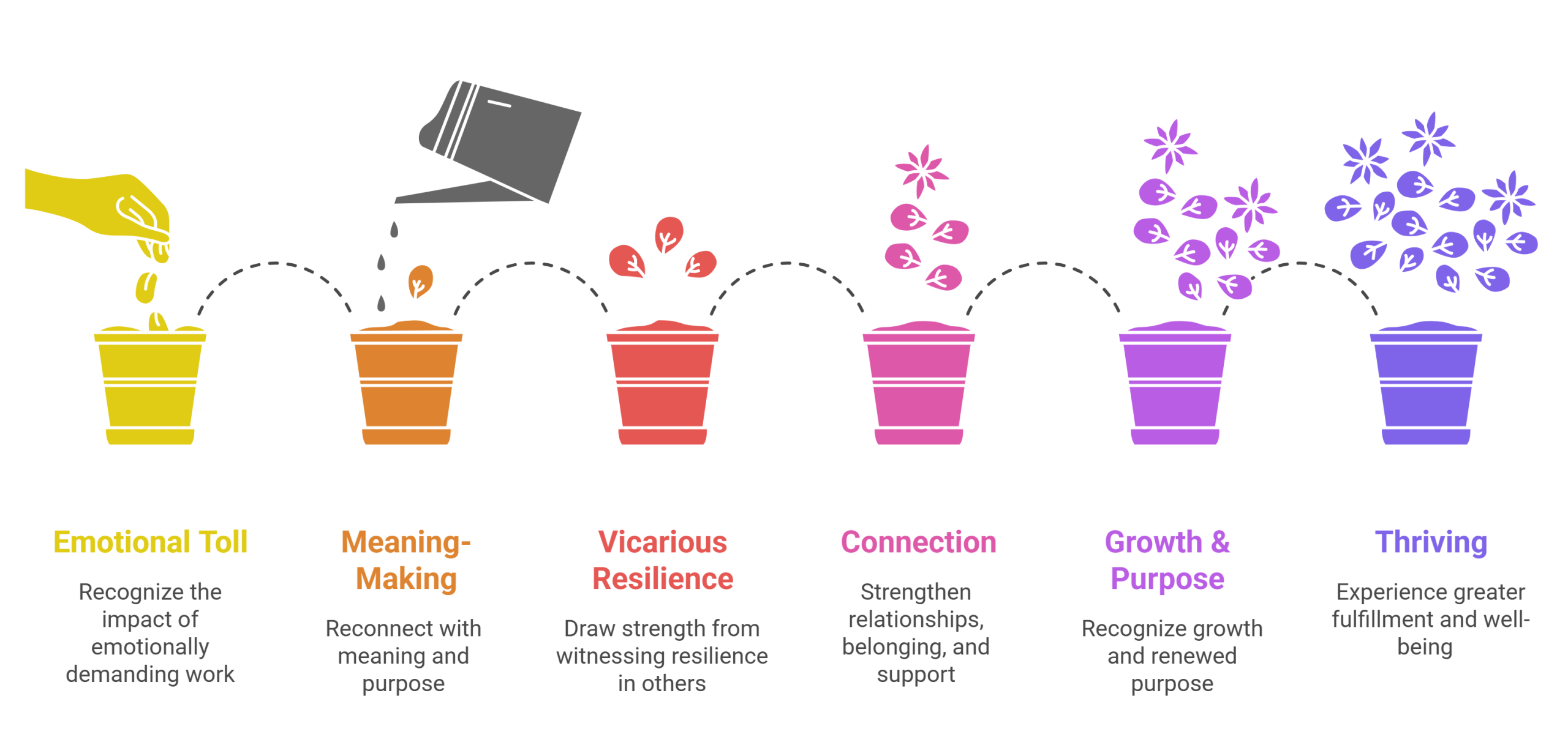
Resilience is often described as the ability to bounce back after adversity. FABULOUS TRANSFORMATION® goes further. Rather than focusing solely on recovering from the emotional toll of trauma-exposed and caregiving work, the framework creates opportunities to understand those experiences, make meaning from them, and move forward with greater awareness, connection, and purpose.

FABULOUS TRANSFORMATION® pathway from emotional toll through meaning-making, vicarious resilience, connection, growth and purpose, to thriving.

One important part of this process is vicarious resilience. Just as repeated exposure to another person’s trauma can affect a professional’s worldview, witnessing the courage, strength, and healing of the people they serve can also have a profound impact. Their resilience can become a source of perspective, inspiration, and renewed belief in the value of the work.

Meaning-making also plays an important role in transformation. Difficult professional experiences can challenge assumptions about work, identity, purpose, and even the way someone understands the world. Finding ways to integrate those experiences can help professionals reconnect with what matters to them and recognize how they have changed and grown through the work.

Over time, that process can contribute to vicarious post-traumatic growth—positive change that develops through engagement with the trauma and recovery of others. It can also strengthen compassion satisfaction: the sense of fulfillment that comes from knowing that one’s work has meaning and makes a difference.

Transformation does not mean eliminating the difficult realities of trauma-exposed work. It means developing the awareness, resources, relationships, and perspective to move through those realities differently—with greater resilience, deeper connection, renewed purpose, and the capacity for continued growth.

Grounded in Grief, Trauma and Growth

FABULOUS TRANSFORMATION® draws from Barbara Rubel’s decades of work in grief, trauma, loss, and thanatology—the study of death, dying, grief, and bereavement. This foundation recognizes that emotionally demanding work can affect more than stress levels. It can challenge a professional’s sense of identity, meaning, purpose, and expectations about the work they do.

Concepts such as meaning reconstruction help explain why making sense of difficult experiences can be an important part of moving forward. Nonfinite loss recognizes losses that may continue without a clear endpoint, including changes to professional identity, expectations, or a future once imagined. Disenfranchised grief acknowledges losses that may be significant to the person experiencing them even when they are not recognized or supported by others.

FABULOUS TRANSFORMATION® also draws on concepts of post-traumatic growth and vicarious resilience, recognizing that difficult experiences do not have to be understood only in terms of their negative impact. Professionals may also discover new perspectives, greater awareness of personal strengths, deeper relationships, renewed meaning, and an increased appreciation for what matters to them.

Together, these perspectives help explain an important principle underlying FABULOUS TRANSFORMATION®: resilience is not simply about enduring difficult work or returning to a previous state. Transformation can involve integrating what has been experienced, recognizing what has changed, and finding a meaningful way forward.

Resilience Is Both Individual and Organizational

Professionals can develop greater awareness, establish healthier boundaries, strengthen relationships, and build skills that support resilience. But individual strategies alone cannot address every factor that contributes to compassion fatigue, vicarious trauma, and occupational stress.

Workplace culture matters. So do leadership, supervision, peer support, recognition, organizational policies, staffing and resources, working conditions, and opportunities for meaningful connection. These conditions can either support employees as they navigate emotionally demanding work or make that work more difficult to sustain.

FABULOUS TRANSFORMATION® recognizes both sides of resilience. It helps professionals identify the perspectives, relationships, and practices within their control while helping organizations examine the environments in which their people are expected to work and thrive.

When individual resilience is supported by organizational commitment, well-being becomes more than a personal responsibility. It becomes part of the culture—creating stronger connections, greater job satisfaction, and a more sustainable foundation for the people who do emotionally demanding work.

Bring FABULOUS TRANSFORMATION® to Your Organization

Griefwork Center, Inc. brings FABULOUS TRANSFORMATION® into organizations through engaging, evidence-informed speaking and training designed for professionals whose work involves trauma, grief, loss, caregiving, and the emotional demands of helping others.

Led by Barbara Rubel, creator of FABULOUS TRANSFORMATION®, these programs translate the methodology into practical learning experiences that help professionals recognize the impact of their work, strengthen resilience, reconnect with meaning and purpose, and build supportive relationships. At the same time, organizational leaders gain a deeper understanding of the workplace conditions that influence employee well-being and sustainable resilience.

Whether presented as a keynote or incorporated into organizational training, FABULOUS TRANSFORMATION® gives teams a shared language for understanding emotionally demanding work—and a framework for moving forward with greater awareness, connection, resilience, and purpose.

Ready to bring FABULOUS TRANSFORMATION® to your team?

Request a Program for Your Team