

Professionals who regularly support people experiencing trauma, illness, loss, crisis, or distress can be profoundly affected by the work they do. Over time, repeated exposure to the suffering of others can contribute to compassion fatigue, affecting not only individual well-being but also how people engage with their work, their colleagues, and the people they serve.

Compassion fatigue is an occupational concern for organizations whose employees are routinely exposed to the pain and trauma of others. It is closely associated with burnout, which develops in response to ongoing workplace stress [1], and secondary traumatic stress, which can result from indirect exposure to another person’s traumatic experiences.

For healthcare professionals, first responders, behavioral health providers, social service professionals, victim service providers, and others in helping roles, recognizing compassion fatigue is not simply a matter of encouraging greater self-care. Organizations also have a role in understanding the conditions that contribute to it and creating environments that support resilience, professional well-being, and continued engagement in meaningful work.

What Is Compassion Fatigue?

Compassion fatigue describes the physical, emotional, and psychological impact that can develop when professionals are repeatedly exposed to the suffering, trauma, and distress of the people they help. It can affect a person’s ability to remain emotionally engaged in the work and may influence their sense of effectiveness, connection, and professional well-being.

The term is used somewhat differently across the professional literature, which can create confusion about what compassion fatigue actually means. Some models describe compassion fatigue in relation to both burnout and secondary traumatic stress, while other literature distinguishes among the three [2, 3]. For organizations, understanding the differences is more important than treating every form of occupational distress as the same problem.

An employee struggling with workload, organizational pressures, or inadequate resources may need a different response than someone experiencing trauma-related effects from repeated exposure to the suffering of others. Recognizing what is contributing to the distress can help organizations identify the conditions that actually need to change.

Compassion Fatigue, Burnout, and Secondary Traumatic Stress

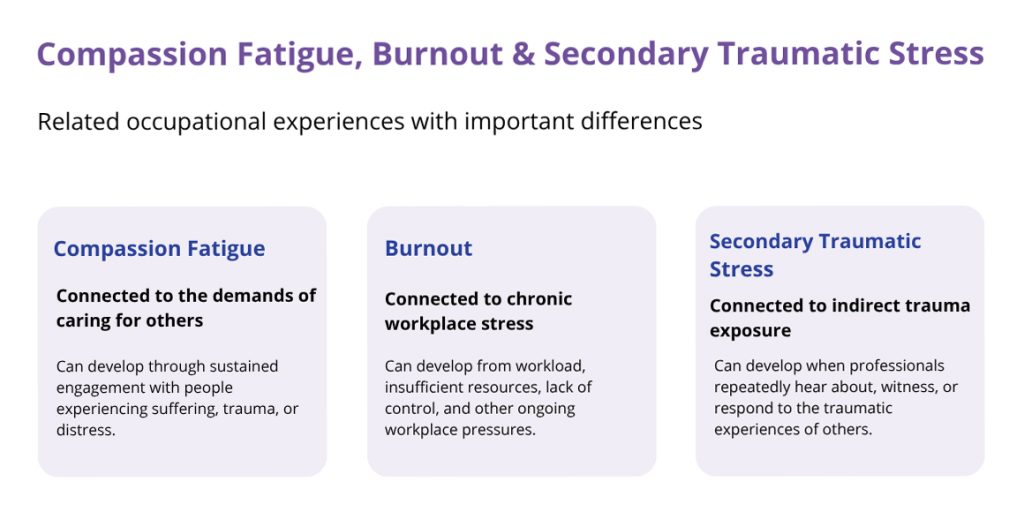
Compassion fatigue, burnout, and secondary traumatic stress are often discussed together, but the terms describe different aspects of occupational distress. Understanding the differences can help organizations identify what employees are experiencing and respond more effectively.

Burnout develops primarily from conditions within the work environment. Chronic workload pressures, insufficient resources, lack of control, unclear expectations, and prolonged workplace stress can contribute to emotional exhaustion, disengagement, and a reduced sense of professional effectiveness. Burnout can occur in virtually any occupation; direct exposure to another person’s trauma is not required.

Secondary traumatic stress is associated with indirect exposure to trauma. Professionals may hear traumatic accounts, witness the consequences of traumatic events, or repeatedly support people who have experienced them. Over time, some helpers may develop trauma-related reactions themselves, including intrusive thoughts, heightened alertness, avoidance, or emotional distress.

Comparison of compassion fatigue, burnout, and secondary traumatic stress, showing the different occupational experiences associated with each.

Compassion fatigue develops in the context of sustained engagement with the suffering and distress of others. It can affect professionals emotionally, psychologically, and physically and may overlap with experiences of burnout or secondary traumatic stress. Unlike burnout, however, compassion fatigue is specifically connected to the demands of caring for or helping others who are experiencing suffering, trauma, or distress.

That distinction has practical consequences. Reducing workload or improving organizational processes may help address burnout, but those changes alone may not address the effects of repeated trauma exposure. Likewise, teaching an employee individual coping strategies cannot correct chronic understaffing, unrealistic demands, or an organizational culture that discourages asking for support.

Effective prevention and response begin with identifying what is contributing to the distress rather than treating every sign of exhaustion or disengagement as the same problem.

What Compassion Fatigue Looks Like in the Workplace

Compassion fatigue does not always appear as an employee saying, “I am struggling with compassion fatigue.” More often, organizations may notice changes in how people feel, interact, and function at work.

Professionals who were once deeply engaged may become emotionally depleted, irritable, detached, or less able to connect with the people they serve. Concentration and decision-making may become more difficult. Some may experience sleep disruption, intrusive thoughts, heightened anxiety, physical exhaustion, or a growing sense that they have little left to give.

Organizations may notice changes in:

Engagement & emotional connection

Team communication & collaboration

Concentration & decision-making

Attendance & morale

Within a team, the effects may appear differently. Increased conflict, cynicism, withdrawal, reduced collaboration, absenteeism, or declining morale can signal that occupational stress is affecting more than one individual. In helping professions, emotional distancing can also become a form of self-protection when continued exposure to suffering begins to feel overwhelming.

These changes should not automatically be interpreted as a lack of commitment or caring. In fact, compassion fatigue can occur precisely because professionals have spent significant time caring for and responding to people in difficult circumstances.

For organizations, the important question is not simply whether employees are showing signs of stress. It is what is driving that stress. Workload and workplace conditions, repeated exposure to trauma and loss, insufficient recovery time, and cumulative occupational demands can overlap. Recognizing those contributing factors is the first step toward choosing an appropriate response.

Why Helping Professionals Are Especially Vulnerable

Helping professionals often enter their fields because they want to make a meaningful difference in the lives of others. But the same work that provides a strong sense of purpose can also require repeated exposure to trauma, suffering, illness, crisis, death, and loss. [4]

Healthcare and hospice professionals may regularly support patients and families through serious illness and death. Behavioral health and social service professionals may hear traumatic experiences day after day. Victim service providers work closely with people affected by violence and abuse, while first responders may repeatedly encounter emergencies, injury, death, and human suffering.

medical professional sitting quietly by a window, looking out and reflectingThese experiences do not occur in isolation. Professionals may move from one difficult case, patient, call, or crisis directly to the next, often with little opportunity to process what they have witnessed or absorbed. At the same time, they are expected to remain attentive, compassionate, competent, and emotionally available to the next person who needs them.
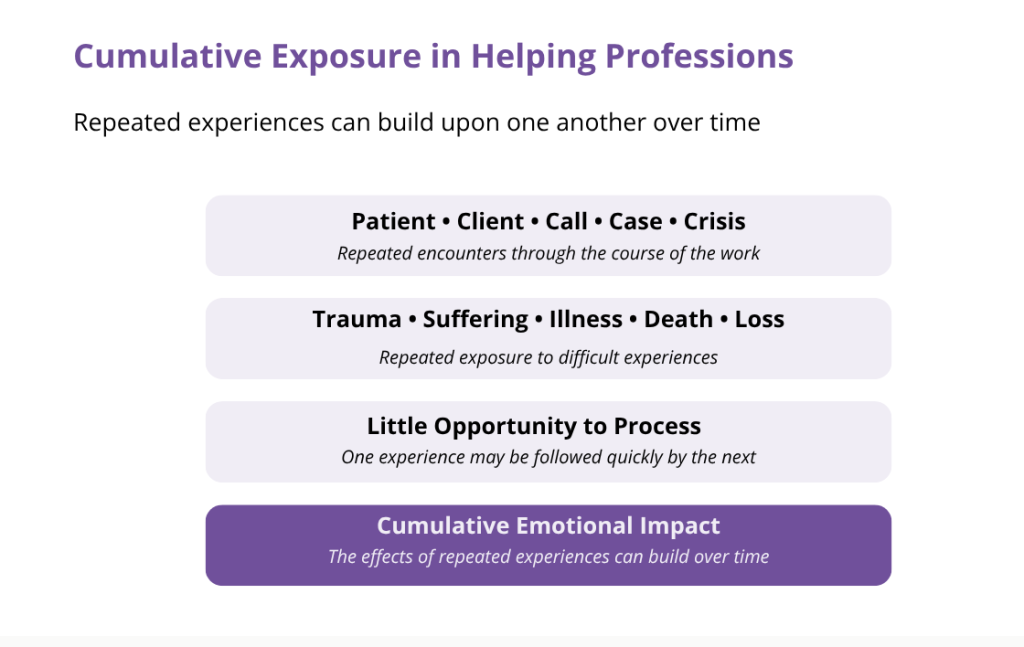

Over time, the cumulative nature of this work matters. It is not necessarily one extraordinarily difficult experience that creates the greatest strain. Repeated exposure, unresolved grief, occupational stress, and the continuing responsibility to care for others can build upon one another.

In many helping professions, exposure to suffering and loss is not an unusual event that can simply be removed from the workplace; it is an inherent part of the work itself. Recognizing this cumulative impact shifts the conversation away from asking why an individual is not coping better and toward understanding what the work itself asks of people who perform it.

The Role of Grief and Cumulative Exposure

Grief in the helping professions is not limited to the death of a patient, client, or person served. Professionals may also experience grief connected with repeated losses, difficult outcomes, changes in a person’s health or functioning, situations they could not change, and the emotional weight of witnessing suffering over time.

Much of this grief may go unrecognized. A professional may have little time to acknowledge one difficult experience before another person needs care. Barbara’s Palette of Grief® reflective practice offers another way to recognize and explore grief reactions that may be difficult to identify or put into words. Some losses may not be openly discussed or formally recognized at all. Yet the absence of time or permission to process an experience does not mean that it has had no impact.

Cumulative exposure matters because each experience occurs in the context of what came before it. A difficult patient outcome, traumatic call, client’s story, or death may intersect with previous professional experiences as well as losses in a person’s own life. Over time, these layers of exposure can affect emotional reserves, perceptions of the work, and the ability to remain fully engaged.

Diagram showing how repeated encounters with trauma, suffering, illness, death, and loss, with little opportunity to process them, can build into cumulative emotional impact for helping professionals.

Understanding the role of grief adds an important dimension to the conversation about compassion fatigue. It encourages organizations to look beyond workload and stress alone and recognize that employees may also be carrying the accumulated emotional impact of what they have witnessed, heard, and been unable to change.

Addressing compassion fatigue therefore requires more than helping professionals become better at enduring difficult work. It also requires acknowledging the human impact of repeatedly accompanying others through trauma, crisis, suffering, and loss.

Why Self-Care Alone Isn’t Enough

Self-care can play an important role in helping professionals restore energy, maintain boundaries, and support their physical and emotional well-being. But compassion fatigue is an occupational issue, and individual self-care cannot address every factor that contributes to it.

An employee can develop healthy coping strategies and still face chronic understaffing, excessive workloads, repeated trauma exposure, insufficient recovery time, or a workplace culture in which asking for support is discouraged. When these conditions are present, placing the responsibility entirely on the individual can overlook the environment in which the distress is occurring.

This distinction matters because some approaches to workplace well-being unintentionally send the message that employees simply need to become more resilient.

Resilience is valuable, but it should not mean becoming better at tolerating conditions that are unnecessarily harmful or unsustainable.

Organizations can support individual well-being while also examining workload, leadership practices, communication, access to support, opportunities for recovery, and how employees are prepared for and supported through repeated exposure to trauma, suffering, and loss.

The most effective approach is therefore not self-care or organizational responsibility. It is both: equipping professionals with skills that support their own well-being while creating workplace conditions that make those skills possible to sustain.

How Organizations Can Address Compassion Fatigue

Organizations cannot eliminate the difficult realities of work that involves trauma, illness, crisis, suffering, and loss. They can, however, influence how professionals are prepared for that work, supported while doing it, and given opportunities to recover from its cumulative demands.

An effective response begins with understanding what is contributing to employee distress. If chronic workload, staffing, communication, or lack of control is driving burnout, organizational conditions need attention. If repeated exposure to trauma is contributing to secondary traumatic stress, professionals may need education, appropriate support, and opportunities to process the impact of that exposure. When grief and cumulative loss are part of the experience, acknowledging that impact can also be an important part of the response.

Organizations can further support their workforce by creating psychologically safer environments for discussing occupational stress, strengthening supportive leadership and peer connection, encouraging healthy professional boundaries, and making recovery a legitimate part of sustaining demanding work rather than something employees are expected to manage entirely on their own.

Education also matters. When professionals understand compassion fatigue and can recognize their own responses to occupational stress and trauma exposure, they are better positioned to identify what they need, use effective coping strategies, and seek support before distress becomes overwhelming.

The goal is not to remove compassion from demanding work or teach professionals to become unaffected by what they experience. It is to help them continue doing meaningful work without losing the humanity and compassion that make that work possible—and without sacrificing their own well-being in the process.

Barbara Rubel’s Approach to Compassion Fatigue

Through Griefwork Center, Inc., Barbara Rubel has spent decades helping professionals and organizations understand the impact of trauma, loss, grief, and occupational stress. Her approach to compassion fatigue recognizes both sides of the challenge: professionals need practical skills for managing the emotional demands of their work, and organizations need to create conditions that support those skills.

Rather than teaching resilience as simply the ability to withstand more stress, Barbara helps professionals develop greater awareness of how their work affects them and identify strategies that support continued engagement, healthy boundaries, and professional well-being.

Her FABULOUS TRANSFORMATION® framework provides a structured approach for putting those ideas into practice. Through speaking and training programs, Barbara helps participants explore flexibility, attitude, boundaries, understanding job satisfaction, laughter, optimism, self-compassion, and other dimensions of resilience that can influence how they respond to occupational stress and the cumulative impact of helping others.

Programs can be tailored for healthcare and hospice organizations, behavioral health and social service professionals, victim service providers, first responders, and other teams whose work routinely brings them into contact with trauma, crisis, suffering, and loss.

The objective is not simply to help employees feel better for a day. It is to give professionals and organizations a shared language and practical framework for sustaining compassionate, meaningful work over time.

Barbara Rubel, founder of Griefwork Center Inc., is a speaker and author

Compassion Fatigue Speaking and Training for Organizations

Compassion fatigue education is most effective when it reflects the realities of the people in the room. The occupational demands experienced by a hospice team may be different from those facing first responders, behavioral health professionals, victim service providers, or healthcare workers, even when many of the underlying challenges overlap.

Barbara Rubel provides keynotes, workshops, and training programs that can be tailored to an organization’s workforce, setting, and goals. Programs can help participants understand compassion fatigue, distinguish burnout from secondary traumatic stress, recognize the cumulative impact of trauma and loss, and develop practical strategies for protecting their well-being while remaining engaged in meaningful work.

For leaders and organizations, the conversation can also include the workplace conditions that influence professional well-being and the role organizational support plays in sustaining a resilient workforce. This creates a shared understanding of compassion fatigue rather than placing responsibility solely on individual employees.

Programs can incorporate Barbara’s FABULOUS TRANSFORMATION® framework and can be adapted to complement an organization’s existing wellness, resilience, employee support, or professional development initiatives.

Whether the need is a keynote that introduces a new way of thinking about compassion fatigue or a more in-depth training experience, the goal remains the same: help professionals continue doing work that matters without losing themselves in the process.

Frequently Asked Questions About Compassion Fatigue

No. Burnout is generally associated with chronic workplace stress, such as excessive workload, insufficient resources, lack of control, or prolonged organizational pressures. Compassion fatigue develops in the context of sustained engagement with the suffering and distress of others. The two can overlap, but understanding what is contributing to an employee’s distress can help organizations determine what kind of support or workplace changes are needed.

Professionals whose work regularly brings them into contact with trauma, suffering, illness, crisis, or loss may be at risk for compassion fatigue. This can include healthcare and hospice professionals, behavioral health providers, social service and victim service professionals, first responders, and others in helping roles. Repeated exposure and limited opportunities to process difficult experiences can increase the cumulative emotional demands of the work.

Compassion fatigue can develop through sustained engagement with people experiencing trauma, suffering, or distress. Repeated exposure to difficult experiences, the emotional demands of caring for others, limited opportunities for recovery or processing, and workplace stressors may all contribute. Because these factors can overlap, compassion fatigue is best understood in the context of both the work professionals perform and the conditions in which they perform it.

Organizations can address compassion fatigue by looking at both individual and workplace factors. Education and practical coping skills can help professionals recognize and respond to the effects of demanding work, while supportive leadership, manageable workloads, peer connection, opportunities for recovery, and appropriate support after trauma exposure can address conditions that contribute to distress. Self-care can be valuable, but it should not carry the entire responsibility for an occupational concern. Research on specific interventions is still developing, and results vary across settings.

Compassion fatigue is generally described in the professional literature as a work-related or occupational response associated with repeated exposure to the suffering or trauma of others, rather than as a specific mental health diagnosis. However, some reactions associated with compassion fatigue or secondary traumatic stress can be significant and may warrant professional support. Compassion fatigue should not be used to self-diagnose or replace an evaluation by a qualified mental health professional.

Compassion fatigue training focuses specifically on the occupational impact of repeatedly helping people who are experiencing trauma, suffering, crisis, or loss. Rather than addressing workplace well-being only in general terms, training can help professionals understand compassion fatigue, distinguish it from related experiences such as burnout and secondary traumatic stress, recognize the cumulative impact of their work, and develop practical strategies for sustaining their well-being. For organizations, it can also create a shared language for discussing how workplace conditions and support affect the people doing demanding helping work.

Support the People Who Support Others

If compassion fatigue, occupational stress, or repeated exposure to trauma and loss is affecting your workforce, Barbara can tailor a speaking or training program to the needs of your organization and the professionals you serve.

Request a Program For Your Team

References

[1] World Health Organization. (2019). Burn-out an “occupational phenomenon”: International Classification of Diseases. WHO.

[2] Cocker, F., & Joss, N. (2016). Compassion fatigue among healthcare, emergency and community service workers: A systematic review. International Journal of Environmental Research and Public Health, 13(6), 618. https DOI: 10.3390/ijerph13060618. PubMed.

[3] Newell, J. M., Nelson-Gardell, D., & MacNeil, G. (2016). Clinician responses to client traumas: A chronological review of constructs and terminology. Trauma, Violence, & Abuse, 17(3), 306–313. DOI: 10.1177/1524838015584365. PubMed.

[4] Peters, E. (2018). Compassion fatigue in nursing: A concept analysis. Nursing Forum, 53(4), 466–480. PubMed.

NOTE: The information on this website is provided for educational and professional training purposes. Compassion fatigue and secondary traumatic stress are occupational concerns that may benefit from both organizational training and individual clinical support. Individuals experiencing significant mental health symptoms should seek evaluation and treatment from a licensed mental health professional.