



Compassion Fatigue Speaker and Training Programs for Healthcare, First Responders, and Care Professionals

Barbara Rubel of Griefwork Center, Inc. is a nationally recognized compassion fatigue speaker, author, and trainer whose programs have served healthcare institutions, hospice and palliative care organizations, first responder agencies, and social service networks across the country. Her work operates at the intersection of clinical training and organizational transformation – not a one-hour motivational talk, but a structured, evidence-informed framework for measurable and sustained recovery from vicarious trauma.

Compassion fatigue is one of the most pervasive and under-addressed challenges facing the healthcare workforce, first responder community, and every professional whose daily work requires deep empathetic engagement with human suffering. It is not a character flaw, a weakness, or simple burnout – it is a predictable, measurable occupational response to sustained exposure to trauma, grief, and crisis. And like most occupational hazards, it responds to training, structure, and organizational commitment.

At Griefwork Center, Inc., Barbara Rubel has spent decades developing and delivering evidence-informed compassion fatigue training programs designed specifically for organizations that cannot afford to lose their people to silent, invisible depletion. This page describes what compassion fatigue is, why training matters, and what the Griefwork Center’s programs offer organizations ready to take action.

Book Barbara to SpeakCompassion Fatigue Programs

What is a Compassion Fatigue Speaker?

The FABULOUS TRANSFORMATION™ Framework

At the core of Barbara Rubel’s training is the FABULOUS TRANSFORMATION™ – a proprietary resilience framework built on eight evidence-aligned drivers of recovery from vicarious trauma and compassion fatigue:

The FABULOUS acronym stands for:

  • F – Flexibility: Developing adaptive responses to occupational stress rather than rigid coping patterns that become liabilities under sustained exposure.
  • A – Attitude: Examining how cognitive framing affects emotional resilience and long-term career sustainability.
  • B – Boundaries: Understanding how professional boundaries function as protective structures – not emotional walls – in trauma-facing roles.
  • U – Understanding: Building self-awareness about personal risk factors and organizational contributors to compassion fatigue.
  • L – Laughter: Recognizing the healing and neurological role of humor and levity as clinical tools in resilience, not dismissals of suffering.
  • O – Optimism: Cultivating evidence-based optimism as a protective factor – distinct from toxic positivity – in high-exposure professional environments.
  • U – United: The relational and peer dimensions of resilience; the organizational case for collective healing over isolated individual coping.
  • S – Self-Compassion: Completing the model with integrated resilience principles.

This framework is not generic wellness messaging. It is a structured, named methodology that organizations can reference, track, and build upon across multiple training engagements, peer support programs, and supervisory structures.


Who Benefits from Compassion Fatigue Training

The research is clear: compassion fatigue does not discriminate by professional title. Any role requiring sustained empathic engagement with human suffering generates secondary traumatic stress exposure.  Griefwork Center’s compassion fatigue training programs are designed for organizations and teams that operate on the front lines of human crisis. This includes:

  • Healthcare professionals: Physicians, nurses, physician assistants, social workers, therapists, and allied health staff working in acute care, oncology, emergency medicine, behavioral health, hospice, and palliative care settings. These professionals face compounding trauma exposure that standard employee assistance programs are not equipped to address.
  • First responders and Emergency personnel: Law enforcement officers, firefighters, paramedics, EMTs, and 911 dispatchers whose occupational reality involves repeated exposure to traumatic events, mass casualty incidents, and the cumulative weight of community crisis. Compassion fatigue in first responder populations is significantly under identified and undertreated.
  • Social workers and Human Services professionals: Case managers, child protective services workers, homeless services staff, domestic violence advocates, and substance use counselors who navigate complex trauma in client populations while managing institutional resource constraints and systemic secondary stressors.
  • Chaplains, Hospice, and palliative care teams:: Supervisors, managers, HR professionals, clinical directors responsible for workforce wellbeing and retention
  • Organizational leaders and supervisors: Managers who carry both their own compassion fatigue risk and the secondary obligation of supporting staff through theirs. Training leaders is often the highest-leverage intervention point for systemic change.


Learn More About BarbaraView Barbara's Books

What is Compassion Fatigue?

Book Barbara to SpeakRave Reviews

Why Organizational Training Matters More Than Individual Coping

Bring Barbara to Your Organization

Barbara Rubel is available for keynote presentations, half-day and full-day workshops, multi-session training series, and consultation on vicarious trauma-responsive program development. She has spoken to hospital systems, hospice networks, law enforcement agencies, first responder organizations, academic medical centers, and professional associations across the country. You can see the list of some of the many places Barbara has spoken here on her website – Where Barbara Has Spoken.

To inquire about program availability, format customization, or scheduling, contact Griefwork Center, Inc. directly through GriefworkCenter.com.

Book Barbara for a speaking engagement or training today.


Book Barbara to Speak

Note: The information on this page is educational and training-oriented in nature. Compassion fatigue and secondary traumatic stress are occupational concerns that may benefit from both organizational training and individual clinical support. For individuals experiencing significant mental health symptoms, consultation with a licensed mental health professional is recommended.

AUTHOR and THOUGHT LEADER IN COMPASSION FATIGUE

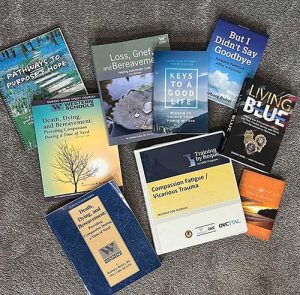
Barbara is the author and co-author of several books focused on grief, loss, and compassion fatigue. Her work has helped professionals across the country better understand the emotional impact of caregiving and develop healthier ways to support themselves and others.

books Barbara Rubel has authored and co-authored

View Barbara's Books

What Clients are Saying

On behalf of the entire staff at CME LLC, I would like to thank you for participating in the US Psychiatric and Mental Health Congress. Your contribution was greatly appreciated and added greatly to the success of the conference.

Carol R. Duba, BSN, RN, MAManager, US Psychiatric & Mental Health Congress

Thank you for your presentation at the Blaustein Pain Grand Rounds entitled “Preventing Compassion Fatigue While Providing Compassionate Care”. You did a superb job! I believe your talk brought about a renewal of energy and a more healthy regard for what we are able to do with our patients.

James N. Campbell, M.D.Johns Hopkins Medicine, Department of Neurosurgery

Thank you for a truly memorable keynote at our 29th annual COVA conference. The toys were a hit and attendees left with much-needed tools to improve their wellness.

Nancy LewisExecutive Directive COVA, Colorado Organization for Victim Assistance

Thank you again for giving a presentation at the Supportive and Palliative Care Conference yesterday. Your presentation was very well received. I hope we will cross paths again in the near future

Rudolph M. Navari, M.D., Ph.D.Director, Notre Dame Cancer Institute

Our attendees at the 10th Annual Wyoming Victim Services Conference are just raving about how much fun your presentation was . . . Thank you for making our conference a success.

Brandy FinleyWyoming Office of the Attorney General

Thank you for agreeing to speak at our annual spring conference in Destin Fl. It was the highlight of the conference for many attendees.

Alicia E. Hall, RN, MAExecutive Director, Alabama Psychiatric Society

Barbara’s Work Has Been Featured In